2026 Western Video Market Fall Sales Analysis
A few months ago I sold Cowgirls Over Coffee, the online membership for women I built and ran for six years. I sold it in part to allow more time for working on the business side of our growing ranching operation here in the Nebraska Sandhills.
While I’ve been around cattle and ranching my whole life, I am a business executive and communications strategist. I am not an animal scientist nor an ag economist. So I’m leaning into the industry the only way I know how and doing my due diligence. Get the data, build the model, test the assumptions, talk to the people who’ve been here longer and figure out what it all changes about the next best decision.

This fall I went through the catalogs and results of three Western Video Market sales (Cheyenne in August, Ogallala in September, Cottonwood in October): 555 lots, about 73,000 head, $210 million in cattle. I built a lot-level dataset and ran a regression of price per cwt on weight, sex, sale date, origin, vaccination program, implant status, and how each lot was described. Then I wrote up what I found for people who make the decisions I’m considering: when to sell, what to put on the vaccine line, how to sort a calf crop, whether to set a reserve, etc.
A few things that stood out:
Where the calves came from, and how they were presented, mattered more than any practice. Nebraska calves brought $24/cwt (about $132 a head) more than Wyoming calves of the same weight and description. The data can’t separate freight, reputation, and the fact that the Nebraska lots were sorted even and fully described. That last part anyone can copy.
Calling heifer calves “replacement quality” in the catalog, and describing the cow herd behind them, was worth about $47 a head. The best-described heifer lots sold for more than their steer counterparts.
500-weight steer calves brought a middle price (the median) of $479.50/cwt, about $2,637 a head. Inside that one class, lots sold anywhere from $420 to $542.
A booster round of vaccine was worth about $44 a head. A third round added nothing.
Implanted calves sold for about $38 a head less at the same weight. Whether the extra pounds cover that discount depends on your gain and your buyer; the report shows the math.
25 lots didn’t sell this year, against 3 in 2025. Most of them were bred females with reserves set at last winter’s prices.
August was the high in 2026. The same calf brought about $143 a head less in September and $99 less in October. In 2025 it ran the other way. The sale date is a bet on the market’s direction, not a rule.
I am sharing this because I would rather learn in the wild than pretend I have it all figured out. If you raise cattle, buy them, feed them, or market them, I would love to hear where this matches what you see and where it doesn’t.
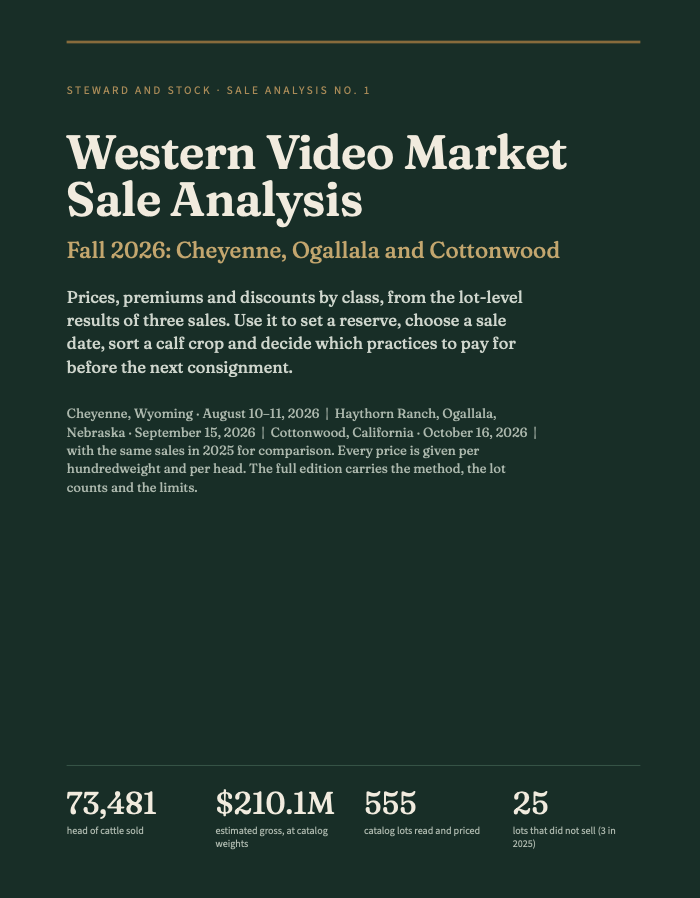
The Steward & Stock Brief | WVM Fall Sales Analysis
Download the full report here.